
Level the Playing Field: Seeing the Win in Every Colour
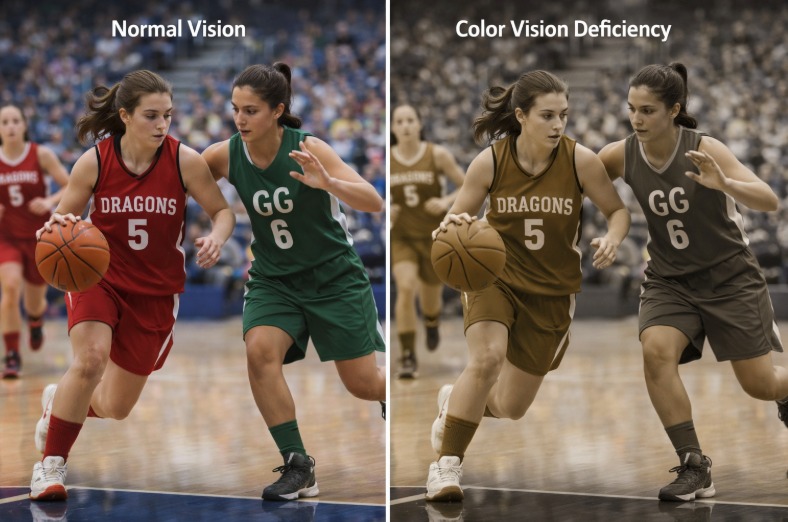
In sports, we often talk about “level playing fields”, but for athletes with colour vision deficiency (CVD), the game is tilted before the first whistle blows. While a spectator might see a vibrant red shirt popping against a lush green pitch, an athlete with CVD often navigates a world of muted, overlapping tones where critical visual cues are lost in a “camouflage” effect.
This isn’t just about naming a colour correctly; it is about two distinct performance barriers: discrimination and identification. In the heat of a match, discrimination is the “game-changer”. If you cannot instantly differentiate a yellowish-green ball from a sun-scorched patch of grass or distinguish a teammate’s orange kit from an opponent’s yellow one, your reaction time slows. In high-speed sports, that split-second hesitation is the difference between a goal and a turnover. This visual “noise” forces the brain to work harder, leading to faster mental fatigue and a disadvantage that no amount of physical training can fully overcome.
The true “game changer” arrives through precision optics. Instead of just tinting the world, the science behind Coloron uses patented technology based on the “Organic Colour System” (OCS). This technology uses subtractive colour mixing to “shift” how light hits the eye, moving the sensitivity of defective receptors into a more optimal position.
By effectively re-mapping the spectrum, these filters pull problematic colours apart—turning a muddy, indistinguishable mess into a high-contrast field of play. For the athlete, this means the environment finally matches their physical talent. It’s not just about seeing the world more beautifully; it’s about restoring the instant, intuitive visual processing required to compete at the highest level. By correcting the science of the eye, we finally level the field for good
How Vision Differs for Athletes
For many athletes, vision goes far beyond the 20/20 clarity tested in an opticians. A “typical sports person” has not only sharp acuity but also finely tuned dynamic vision. This encompasses:
Dynamic Visual Acuity: The ability to see moving objects clearly (like a fast-pitched baseball).
Depth Perception: The capacity to judge distances and the relative position of objects, vital for timing passes and jumps.
Peripheral Awareness: The ability to see and react to things outside the direct line of sight (key for team sports).
Visual Contrast Sensitivity: Discriminating an object against its background, which is crucial in low-light conditions or varied environments.
Colour Vision in the Mix
Color vision, while not always the most emphasized skill compared to speed and strength, plays a subtle yet impactful role. For most athletes, typical color vision:
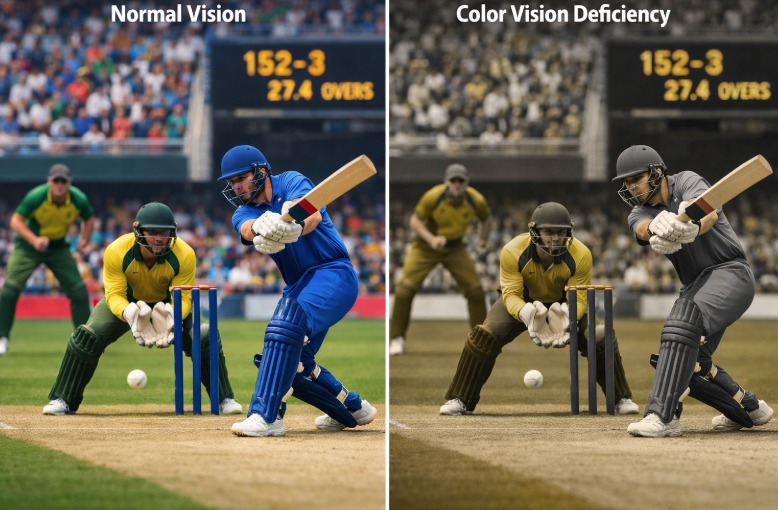
Improves Object Contrast: The brain uses color differences to quickly segment the playing field, making the ball, teammates, and opponents pop against the background. For example, a bright white cricket ball is highly visible against the green grass.
Aids Rapid Identification: Teams wear distinct colored uniforms to make identification instant. In fast-paced games like basketball or soccer, immediately knowing who is a teammate and who is an opponent is essential.
Why “Levelling the Playing Field” is Relevant
When you’re dealing with colour vision deficiency (CVD), this finely tuned system changes. A CVD athlete navigates a slightly different visual landscape. The critical issue isn’t just about naming a color; it’s about differentiation and discrimination.
The Problem of Overlapping Colors: When certain colours (like reds and greens for the most common types of CVD) merge or look similar, distinguishing objects becomes harder. Imagine trying to see a red ball against green grass if both hues seem desaturated or identical. This isn’t just a colour issue; it’s a loss of vital visual cues.
Reduced Contrast: CVD can sometimes lead to reduced perceived contrast between critical elements in certain situations, making reactions a fraction of a second slower. In professional sports, that tiny fraction is often the difference between winning and losing.
So, while we aim for sports to be a pure test of physical ability and strategy, for an athlete with CVD, there is an inherent, unseen visual hurdle. This is why solutions, like the ones you mentioned from Coloron (which are medical devices, as you noted), are so significant—they can technically offer ways to sharpen that differentiation and bring the CVD athlete’s visual world closer to the visual information available to their peers.
Garry Kousoulou FBDO: 30 Years of Optical Excellence
With three decades of expertise in the optical industry, Garry Kousoulou FBDO is a seasoned Dispensing Optician dedicated to pushing the boundaries of sports vision and accessibility. Throughout his 30-year career, Garry has been a vocal advocate for patient-centric care, merging clinical precision with the latest technological advancements to help athletes and the public see the world at its full potential.
Today, Garry is a key partner and advocate for Coloron, working to bring their UK-approved medical device technology to the forefront of sports performance. By combining his deep understanding of ocular science with Coloron’s revolutionary "Organic Color System" (OCS), Garry is helping to bridge the gap for the 1 in 12 men and 1 in 200 women living with colour vision deficiency—ensuring that in the world of sports, no one is left behind by the colours they can’t see.
About Coloron: The Science of Sight
Coloron is a pioneering medical technology brand dedicated to enhancing the lives of those with Red-Green Colour Vision Deficiency (CVD). Developed through a unique collaboration between vision scientists, ophthalmologists, and medical device engineers, Coloron provides functional, high-performance optical solutions that allow individuals to navigate a world full of colour with newfound confidence.
How They Create the Solution
The "magic" behind Coloron isn't magic at all—it’s patented physics. Unlike standard tinted lenses that simply darken the environment, Coloron lenses utilize the Organic Color System (OCS) and the principle of subtractive colour mixing.
- Spectral Shifting: The filters are engineered to "shift" the sensitivity of defective receptors in the eye toward a more optimal position, mimicking typical trichromatic vision.
- Discrimination Over Identification: While naming colours is helpful, Coloron focuses on discrimination—the ability to tell two similar shades apart instantly. This is what restores the vital "reaction time" needed in sports and professional tasks.
- Precision Engineering: Every lens undergoes advanced surface finishing to ensure high-definition clarity, making it a trusted, UK-approved medical device for both children and adults.
By bridging the gap between theory and real-world performance, Coloron ensures that colour blindness is no longer a barrier to excellence—on the pitch, in the classroom, or at work.