
The Blocked Careers:
100+ Roles Limited by CVD
Exploring the hidden glass ceiling of colour blindness and the regulated optical solutions designed to break it.
The Hidden Glass Ceiling: 100+ Careers Blocked by Colour Blindness
For many, the realization that they have Colour Vision Deficiency (CVD) doesn’t happen in a classroom. It happens in a recruitment office, halfway through an application for a dream job.
Imagine training for years to be a pilot, electrician, or engineer, only to be told at the final medical hurdle that your eyes are “defective.” In the UK, over 100 career roles are restricted or entirely blocked for those with colour blindness. This isn’t just a minor inconvenience; it is a hidden glass ceiling. But as technology evolves, so must our approach to “functional sight.”
Why Colour is a Professional Barrier
In the industrial and digital world, colour is a universal language for safety. Whether it’s the wiring in a junction box, the navigation lights on a runway, or the status indicators on a medical monitor, we use colour to signal “Safe” vs. “Danger.”
When the M (green) and L (red) cones in the eye overlap—the biological cause of red-green deficiency—that language becomes a blur. Historically, regulatory bodies have implemented “hard stops” on hiring anyone who fails an Ishihara plate test.
The “Blocked” List
The careers affected by CVD generally fall into three high-stakes categories:
-
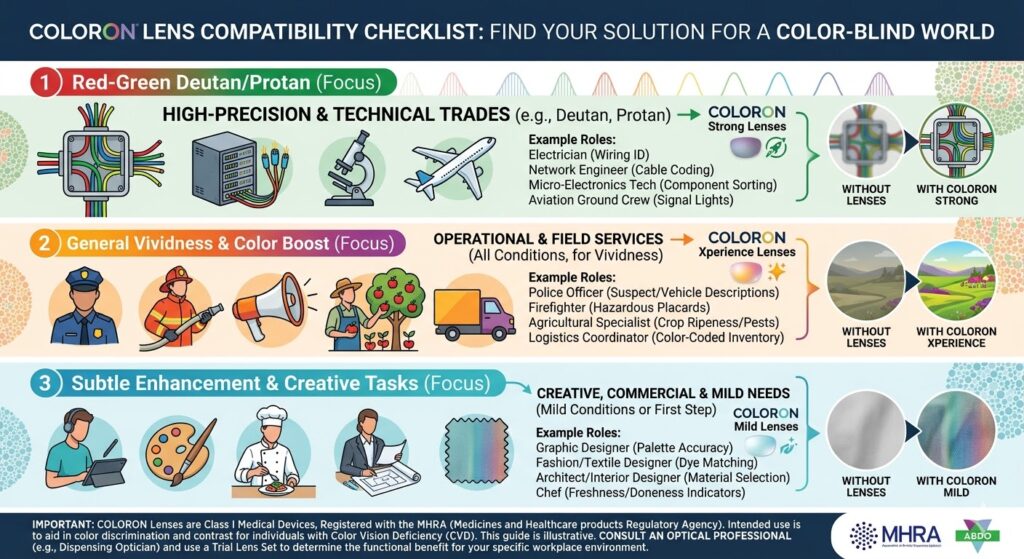
Safety-Critical Roles: Aviation (Pilots), Maritime (Officers), and Railways (Drivers). Here, red/green differentiation is non-negotiable for public safety.
-
Technical Trades: Electricians, Data Technicians (fiber optics), and Engineers. Misidentifying a phase wire or a coded cable can be a fatal error.
-
Specialised Services: Firefighters, Police Officers, and even Chefs or Pharmacists, where identifying chemical flames, litmus tests, or food ripeness is essential.
From “Finding a New Job” to Finding a Solution
For decades, the standard advice for a failed colour test was “find another career.” We believe that is no longer acceptable. In a modern, inclusive workforce, we don’t tell someone with a hearing impairment to “stop listening”—we provide hearing aids.
COLORON is the professional bridge to a more accessible workplace. Our lenses—specifically the Strong and Xperience ranges—act as sophisticated optical filters. By targeting the specific wavelengths where red and green overlap, they “clean up” the signal sent to the brain, enhancing contrast and aiding in colour discrimination.
A Regulated, Professional Path
To be taken seriously by employers and associations like ABDO, a solution must be more than a “hack.” COLORON lenses are Class I Medical Devices registered with the MHRA. This means they are manufactured and governed under strict UK medical standards.
The goal isn’t just to pass a test; it’s to provide functional ability. If a candidate can perform safety-critical tasks accurately using a regulated optical solution, they should have a seat at the table.
Take the First Step
Your career shouldn’t be limited by a 100-year-old testing method. Whether you are a professional looking to regain your edge or a parent protecting a child’s future, there is a path forward.
-
Explore the Range: From Strong filters for technical precision to Mild for everyday wear.
-
Find a Specialist: Test our lenses in a clinical environment with an optical professional.
Don’t let the plates decide your future. Contact COLORON today.
Why Colour is a Professional Barrier
The Safety-Critical Reality
Why Colour is a Professional Barrier
The Safety-Critical Reality
For the majority of the population, colour is a matter of aesthetics—a choice of shirt, the hue of a sunset, or the branding of a favorite product. However, for a professional in a technical or safety-critical field, colour is a data stream. It is a high-speed delivery system for vital information that dictates whether a situation is safe, a system is functional, or a life is at risk. When that data stream is compromised by Colour Vision Deficiency (CVD), the professional barrier is not just a personal challenge; it is a regulatory wall.
The Language of Industry
Our modern infrastructure is built on the “Stop/Go” and “Safe/Danger” binary, almost always represented by red and green. In the electrical trades, colour-coded wiring is the only thing preventing a fatal short circuit. In data centers, the microscopic difference between fiber optic strands determines the connectivity of entire networks. For a pilot or a maritime officer, identifying navigation lights in the dead of night is the difference between a safe passage and a catastrophic collision.
When the M (green) and L (red) cones in the eye overlap too significantly, these distinct signals “muddy” together. To the brain, the data becomes corrupted. This is why industries have historically moved toward exclusion rather than accommodation—it was simply easier to bar entry than to bridge the visual gap.
The Cost of Exclusion
The barrier isn’t just technical; it’s psychological and economic. We are currently facing global shortages in skilled trades and engineering. By maintaining rigid “unassisted” vision standards that date back nearly a century, we are locking out a massive percentage of the workforce who are otherwise highly capable, intelligent, and driven.
This exclusion creates a “hidden” glass ceiling. Many young people are discouraged from pursuing STEM careers or aviation before they even begin, fearing the final medical exam. This is a loss of human capital that modern industry can no longer afford.
Breaking the Barrier
The shift toward functional sight is the key to dismantling this barrier. Just as we use spectacles to correct focus or hearing aids to amplify sound, COLORON lenses serve as a professional tool to clarify colour data. By filtering the overlapping wavelengths of light, these MHRA-registered Class I medical devices allow the user to distinguish between shades that were previously indistinguishable.
We are moving into an era where “colour blind” no longer means “blocked.” It means “requiring a professional optical solution.” By adopting regulated, evidence-led tools, we can ensure that a person’s career is defined by their skill and dedication, not by the limitations of their unassisted biology.